
Light-Curing System Impact on Adhesive Performance
Light-curing systems play a critical role in achieving consistent adhesive performance, yet they are often overlooked as a source of inconsistent results. To explore how curing equipment influences performance and what engineers can do to optimize outcomes we spoke with William Quinn, Territory Sales Manager at Dymax Engineering Adhesives Ireland Ltd.
Questions About Common Customer Mistakes
Q: What are some of the most common mistakes customers make when pairing light-curing equipment with a specific adhesive chemistry?
- If they already have curing equipment on site, they will repurpose it, even if it's not suitable for the adhesive's wavelength or the assembly's geometry.
- They buy a cost-effective lamp or end up with poor curing performance.
Q: Share an example where a customer tried to use the wrong type of light-curing system for their process, and what problems it caused.
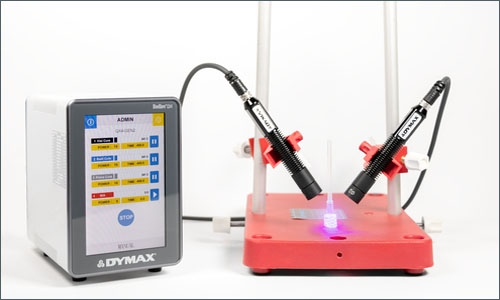
They used curing wands that were not properly configured, and there wasn't enough light on the assembly, resulting in shadow areas and shrinkage bubbles.
Q: Why might a particular assembly process not work properly for bonding?
If the bond gaps are too small, they don’t allow for adequate material coverage for load transmission.
Q: What are the warning signs that a curing system and adhesive are not well-matched in a manufacturing process?
Shrinkage bubbles, voids, variability in mechanical testing, and very long curing times.
_________________________________________________________
Questions About Chemistry and Light Compatibility
Q: How does adhesive chemistry influence the type of light-curing equipment to use?
Adhesive is optimized for specific wavelengths.
Q: Why is it important to match the lamp’s wavelength output with the adhesive’s photoinitiator system?
Depth of cure and to achieve the best crosslinking to ensure biocompatibility and mechanical performance.
Q: What problems can occur if the adhesive receives insufficient or inconsistent light energy during curing?
Uncured material can lead to biocompatibility issues and mechanical failure of the assembly.
Q: How does shadowed geometry affect the choice of chemistry or curing equipment?
A formulation with secondary curing mechanisms, e.g., heat or moisture, is needed.
_________________________________________________________
Questions About Process and Equipment Selection
Q: What factors should manufacturers evaluate when selecting light-curing equipment for a new bonding application?
Part geometry, shadow areas, wavelength required, and speed of cure/cycle time.
Q: How do part geometry and fixture design influence the curing strategy?
The larger the geometry, the more light sources or larger light sources would be required to achieve consistent curing. Parts need to be fixed firmly from dispensing to curing to ensure the adhesive bond is not disturbed.
Q: When is a focused spot lamp the better option versus flood curing or conveyor curing?
When parts and bond areas are very small, higher intensities are needed for high-speed production lines.
Q: What role does automation or process speed play when selecting a curing system?
By knowing the throughput and space capability, we can specify the most suitable curing equipment.
_________________________________________________________
Questions About Troubleshooting
Q: If a customer reports inconsistent bonding results, what are the first things you evaluate in their curing setup?
Intensity of cure, dose, uniformity of cure, presence of voids, and shadow areas.
Q: How often do curing problems actually stem from the equipment setup rather than the adhesive itself?
Overwhelmingly, the majority of the time.
Q: What simple tests or measurements can manufacturers perform to confirm they are delivering enough light energy for proper curing?
A simple radiometer check.

Questions About Best Practices
Q: What steps should customers take early in the process to ensure their adhesive chemistry and light-curing equipment are properly matched?
They should contact us for assistance.
Q: How can working with an adhesive supplier early in the design stage help avoid curing issues later
We will advise on the suitability of the adhesive for the substrates and the environmental testing. We will also advise on the configuration of curing equipment to avoid issues such as voids.
Q: What advice would you give engineers who are developing a new assembly process using light-curable adhesives?
Contact us for more information.
Q: If manufacturers remember only one thing about pairing curing equipment with adhesive chemistry, what should it be?
It sounds easier than it is. There’s more to the process than just matching wavelengths.
_________________________________________________________
Enjoying This Content? Let’s Stay Connected.
If you’re finding value in our insights, why not get more of it—delivered right to your inbox? Subscribe to receive the latest technical articles, white papers, product news, and expert tips.